Fish cleaning in a blur. One of the few women cutting up your catch lives right here
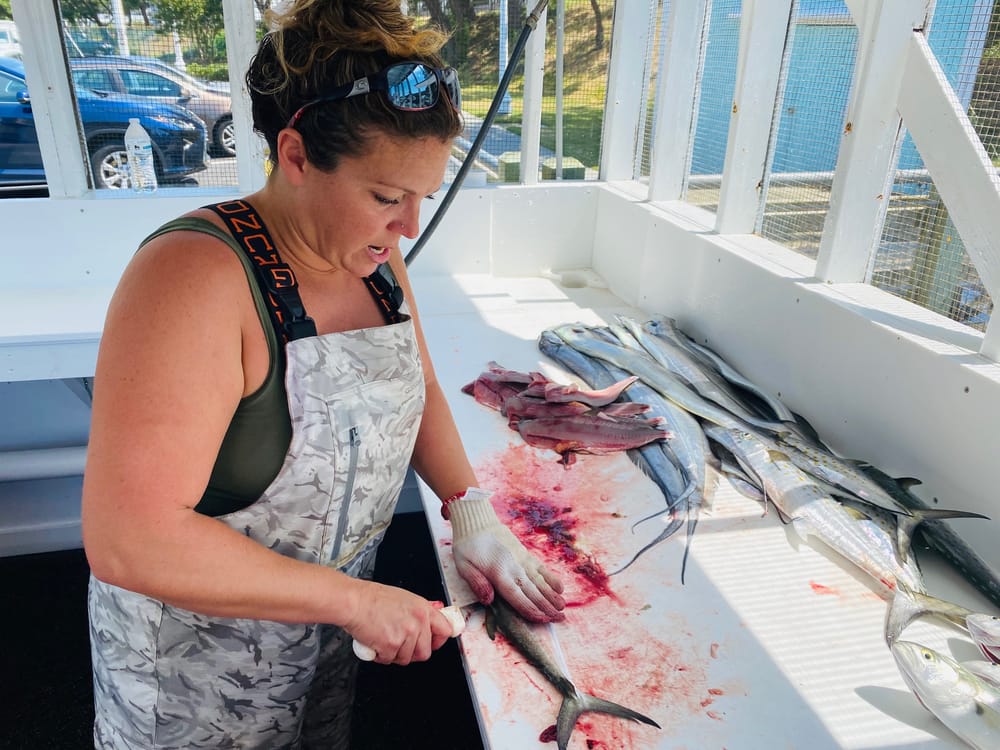
After a slice from the backbone, just past the pectoral fin and into the underside, the knife swims swiftly along the spine to the tail and the entire piece of meat is removed and tossed onto a pile.
Same for the other side of this small bluefish, the beginning of a methodical day spent in a small shack in the parking lot of the Virginia Beach Fishing Center next to the north side of the Rudee Inlet bridge.
When all the bluefish are done, the rib cage is cut out and the knife used to separate the skin from the meat.
The pile is tossed in a bag, tied up and handed to the angler.
"Bluefish. You got a cooler, right."
Spanish mackerel and ribbonfish are next, the same method used over and over until the entire wheel barrow is finished.
The table in the cleaning station is hosed down as a charter boat's mate wheels in another catch.
Scales fly, blood squirts and the heat builds in on another summer day at the cleaning station. A small fan helps, but the full-day trips what will bring in bigger fish like tuna, dolphin and wahoo won't show up until hours later when it will be stinking hot.
Thank God for a slight sea breeze that's keeping most of the flies away.
The fish cleaner wipes off their brow and blows a wild piece of hair from their face before counting this catch.
Meet Ashley Beane - one of the very few women on the east coast who deal with the blood, slime and guts, all the while flashing a welcoming smile and dishing out warm conversation.
This world of stinky, fly-attracting fish is hardly the place for a faint-of-heart girlie-girl.
And while Beane says she can get dolled up with the best of them for her regular job in the family's real estate appraisal business, her stomach stays put just fine when asked to stick her arm into a fish's belly to see what it had been eating.
"My dad always said he had three boys," said the oldest of a trio of siblings. "But he said one of them was born with boobs."
Several waiting on their filets overheard and laughed, and Beane quickly joined in.
"I've been around fishing and hunting since I was a kid," the 37-year-old said. "This is a good way to make a little extra money, be around people and spend more time with my husband."
Mike Beane, a 40-year-old government contractor, has been running boats and cleaning fish all his life. He and Ashley were supposed to get married in March. But Covid-19 got in the way and they took care of the matter at the Justice of the Peace.
A larger ceremony or party will come later, but, as much as the cleaning station is their home away from home, it likely won't be where they decided to hold it.
"Not sure a lot of my friends would come," she said with a laugh.
Mike says he marvels at how quickly his wife learned to improve her techniques to make fish cleaning faster and to get more of the meat.
"Women just learn things their men do a lot better than the guys do," he said. "They have an idea, but they listen and want to learn. People spend a lot of time and money to catch these fish so they want them cleaned right.
"As far as learning anything about fishing goes, I'd rather have a bunch of women any day of the week."
Dressed in light-colored camo bibs to keep as much of the slime off her as possible, Beane continued to plow away at the catches of several half-day-trippers who had caught plenty of bluefish, Spanish and ribbonfish.
The toothy, prehistoric species appropriately named for its long, thin shape makes the ribbonfish one of the few species that bring a disgusting bend to Beane's expression.
"I hate them," she said, counting about 20 from one boat. "My absolute least favorite.
"Those teeth will get you and they have sharp teeth-like things in their gills. Their ballast stones that they have to have so they don't spin, get in your way and dull your knife.
"If there is one thing, they are so good to eat."
Slippery subjects and razor sharp knives often are a recipe for more than a few dangerous slices to the hand. But knocking on the wood of the cleaning table, she said she's never been knifed. A fish-holding glove with wire running through it has helped.
"But gills and fins?" she asked. "Oh yeah, you're gonna get some of that."
Calling it a wrap on the morning trips, Beane had some time to work on appraisals or go check on the couple's farm animals in South Mills, N.C. She loves her horses, goats, chickens and a donkey.
A dog and bird hold down the fort of their Norfolk home.
"Yeah, I married into a freaking farm," Mike said with a laugh. "But that's OK. I met her on a charter and when I saw her rig a ballyhoo and gaff a wahoo, I was like: 'Oh yeah, I'm good.'
"It was an instant attraction."
The deep sea trips wouldn't back into the docks for several hours and Mike would arrive at the fish hut in time to help.
That's when the two really put on a show.
"We have a system and the tuna are so easy to filet," she said. "One of us will cut the loins out and they other will trim the blood line out, clean up the filet and bag them.
"It's really fast and very efficient."
And it puts a little extra money in their pocket, although jokingly they admit that it might not be enough to offset the farm critters.
Doesn't matter, it's much more about the time spent together doing something they love - which including all types of hunting and fishing.
Ashley slides the knife into another fish and blood squirts onto her bibs, prompting an "ooh" from one of the female anglers waiting on her fish to be filleted.
Ashley turns and smiles, explaining that she has accidentally cut too deep into the fish.
"Hazard of the trade. It washes off."